


Top High Visibility Workwear Manufacturers in UAE
08/06/2026
Best FR & Arc Flash Resistant Clothing Manufacturers in 2026
14/07/2026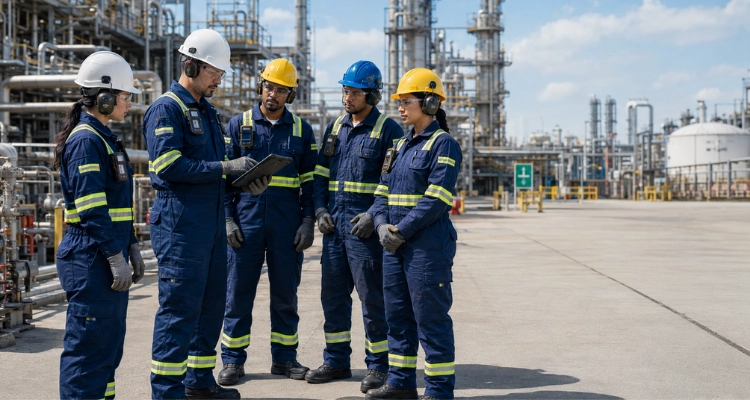
 Yash Agarwala
on
Yash Agarwala
on

Yash Agarwala
Associate Director – ACI Workwear
Yash Agarwala is a Associate Director at ACI Workwear, a company focused on manufacturing high-performance safety garments and industrial workwear. He is actively involved in scaling operations, improving manufacturing efficiency, and building global partnerships.
Oil refinery workers face some of the most severe hazards in any industrial environment – flash fires, arc flash, chemical splashes, toxic gases, and extreme heat. The right workwear is not just a compliance checkbox. It is the last barrier between a worker and a life-threatening injury.
At minimum, a complete oil refinery PPE programmed must include flame-resistant (FR) clothing certified to NFPA 2112 or EN ISO 11612, anti-static garments to EN 1149-5, high-visibility apparel, arc flash protective clothing for electrical workers, chemical-resistant gloves, safety footwear, and appropriate head, eye, respiratory, and hearing protection.
Every garment must be selected based on the specific hazard level of the task and work zone – not applied as a one-size-fits-all solution across all roles.
This guide covers the full PPE stack, the standards that govern each category, a role-based breakdown, and a practical inspection checklist.
Key Takeaways
- Flash fire and arc flash are the primary workwear hazards in oil refineries – FR clothing certified to NFPA 2112, and arc-rated garments aligned to NFPA 70E are the baseline requirement.
- Workwear selection must be driven by a hazard assessment, not a standard catalogue – different roles and zones carry different risk profiles.
- Garment integrity must be verified before every use – contamination, damage, or improper laundering can override FR certification.
- High-visibility apparel to EN ISO 20471 or ANSI/ISEA 107 Class 2 or 3 is mandatory in vehicle and machinery areas.
- A certified industrial workwear manufacturer with documented traceability reduces compliance risk and simplifies HSE audits.
Why Is PPE So Critical in Oil Refinery Environments?
Oil refineries combine multiple hazard categories in a single operating environment. Workers face flammable gases and vapours, live electrical equipment, corrosive chemicals, explosive atmospheres, and extreme temperature variation – often simultaneously.
A flash fire in a process area can reach temperatures exceeding 1,000°C in under two seconds. Standard workwear made from synthetic fabrics will melt and bond to skin, dramatically worsening burn injuries. FR clothing self-extinguishes once the ignition source is removed, buying a worker critical seconds to escape.
Arc flash events release explosive bursts of thermal energy from electrical faults. Noise levels across pump stations, compressors, and process units regularly exceed 85dB – above the threshold that causes permanent hearing damage. Chemical exposure risks range from hydrocarbon splashes to hydrogen sulphide leaks, each requiring a different protective response.
No single garment addresses all of these hazards. A complete, layered PPE programme – with every item correctly certified, properly maintained, and role-matched – is the only effective approach.
What Are the Key Safety Standards for Oil Refinery Workwear?
Understanding the applicable standards is the foundation of any workwear specification. Each standard defines the minimum performance a garment must achieve to protect against a specific hazard type.
1. NFPA 2112: Flash Fire Protection for Industrial Workers
NFPA 2112 is the benchmark standard for FR clothing in the oil and gas sectors. It governs performance requirements for garments intended to protect workers against short-duration thermal exposures from industrial flash fires.
Garments certified to NFPA 2112 must pass the ASTM F1930 instrumented manikin test, vertical flame test, heat transfer performance test, and laundering durability requirements across 100 wash cycles. The standard also requires minimum labeling, so workers and procurement teams can verify garment performance directly from the care label.
2. NFPA 70E: Arc Flash Protection in Electrical Environments
NFPA 70E establishes electrical safety in the workplace, including arc flash PPE category requirements. It defines four Hazard Risk Categories (HRC 1-4), each associated with a minimum Arc Thermal Performance Value (ATPV) measured in calories per centimetre squared (cal/cm²).
Workers performing electrical tasks in refineries – instrumentation, switchgear, electrical maintenance – must wear arc-rated FR clothing matched to the incident energy level calculated for that specific task. A garment certified to NFPA 2112 does not automatically qualify as arc rated. The ATPV must be separately verified and matched to HRC requirements.
3. EN ISO 11612: Heat and Flame Protection (European/Export Markets)
EN ISO 11612 is the reference standard for heat and flame protective clothing across European and international export markets. It covers six performance properties: A1 (limited flame spread – surface ignition), A2 (limited flame spread – edge ignition), B (convective heat), C (radiant heat), D (molten aluminum splash), and F (contact heat).
Refinery workwear sourced from certified safety clothing exporters for international projects must carry EN ISO 11612 certification with specific performance codes clearly marked on the label. A garment labelled “EN ISO 11612 A1 B1 C1” has passed flame spread and basic convective and radiant heat tests – but may not cover all refinery hazard scenarios. Always match the performance codes to the actual hazard.
4. EN 1149-5: Anti-Static Protection – The Standard Most Often Overlooked
EN 1149-5 governs the electrostatic properties of protective clothing used in potentially explosive atmospheres. In oil refineries – where flammable vapours are present across process areas, tank farms, and loading bays – anti-static workwear is not optional. A static discharge from non-certified clothing can ignite a flammable atmosphere.
EN 1149-5 requires garments to dissipate electrostatic charges safely to earth through the fabric structure. Anti-static properties must be maintained throughout the garment service life and must be verified after laundering. This standard is absent from most competitor workwear guides – yet it is a fundamental requirement for any operating area classified as a Zone 1 or Zone 2 explosive atmosphere under ATEX/IECEx.
5. IEC 61482-2: Arc Flash Protective Clothing (European Standard)
IEC 61482-2 is the European equivalent of NFPA 70E’s arc flash protection requirements. It defines two test methods – Arc Rating (ATPV or EBT) and Box Test (APC 1 or APC 2). Garments for electrical workers in European refineries must be certified to this standard, with the arc protection class matched to the calculated incident of energy.
Additional Reference Standards
- ASTM F1506 – Minimum performance for FR textiles in arc flash protective clothing
- EN 13034 – Protective clothing against liquid chemical splashes (Type 6 or Type 4)
- EN ISO 20471 – High-visibility clothing (Class 1, 2, or 3 based on risk level)
- ANSI/ISEA 107 – North American equivalent for high-visibility safety apparel
- EN ISO 20345 – Safety footwear (SB, S1, S2, S3 classifications)
What Is the Complete PPE Stack for Oil Refinery Workers?
A complete refinery PPE programme operates in layers from head to foot. Each layer addresses a specific hazard category and works in combination with the others.
1. Head Protection: Safety Helmets for Refinery Operations
Industrial safety helmets protect workers from falling objects, accidental impacts, and overhead hazards – all common in refinery turnaround and maintenance activities. Helmets must meet EN 397 (Europe) or ANSI Z89.1 (North America) as a minimum.
In areas with electrical hazards, electrically insulating helmets are required. Helmets with integrated face shield attachments, chin straps, and ventilation systems improve comfort and compliance on long shifts. Helmet-mounted gas detection clips and lamp brackets are common in confined space entry tasks.
2. Respiratory Protection: Toxic Gas and Vapour Environments
Respiratory protection is critical in refinery and petrochemical environments. Workers may be exposed to hydrogen sulphide (H₂S), benzene, hydrocarbon vapours, sulphur dioxide, and airborne particulates – depending on their operating zone.
Half-face respirators with the correct filter cartridge are suitable for lower-concentration exposures. Full-face respirators provide combined eye and respiratory protection. Supplied air breathing apparatus (SABA) or Self-Contained Breathing Apparatus (SCBA) is required for high-concentration environments, confined space entry, and emergency response.
Respiratory PPE selection must be based on the specific gases present and their concentration – identified through workplace atmospheric monitoring. Fit testing is a regulatory requirement in most jurisdictions and must be recorded.
3. Eye and Face Protection: Chemical Splash and Impact Hazards
Flying debris, chemical splashes, intense UV light from welding, and pressure-related risks make eye and face protection mandatory across most refinery work areas. Safety goggles with chemical-resistant, anti-fog coatings are the standard for chemical handling areas.
Face shields are required for high-splash-risk tasks – including acid handling, caustic chemical operations, and pressure vessel opening. Welding helmets with auto-darkening lenses protect workers from performing hot work on plant and pipework. Eye protection must comply with EN 166 (Europe) or ANSI Z87.1 (North America).
4. Hearing Protection: Often Underspecified in Refinery PPE Programmes
Refinery operating environments – pump stations, compressor halls, process units – routinely generate noise levels between 85dB and 105dB. Prolonged exposure above 85dB causes irreversible hearing damage.
Earplugs (SNR 25-37dB attenuation) or earmuffs (SNR 27-35dB) must be provided and worn in designated high-noise zones. Hearing protection must be matched to the specific noise exposure level – over-attenuation impairs communication and creates its own safety risk.
5. Body Protection: The FR and Anti-Static Clothing Layer
The primary protective layer for most refinery workers is the FR coverall. Single-piece coveralls provide consistent coverage with no gap at the waist – a critical advantage in flash fire scenarios. FR shirts and trousers are suitable for lighter roles, but all layers must be FR-rated and anti-static certified.
Inherent FR vs Treated FR Fabrics – Which Should You Specify?
Property | Inherent FR Fabric | Treated FR Fabric |
FR source | Built into the fibre at molecular level | Chemical treatment applied to base fabric |
Protection durability | Permanent – does not wash out | Can degrade with heavy laundering or contamination |
Typical fibres | Nomex, Modacrylic, Kevlar blends | FR-treated cotton, Proban-treated cotton |
Weight | Typically, lighter for equivalent protection | Can be heavier |
Cost | Higher upfront cost | Lower upfront cost |
Best for | High-frequency wash environments, extended service life | Cost-sensitive procurement, moderate-wash programmes |
Certification longevity | Full-service life | Must be re-verified after heavy laundering |
Inherent FR fabrics such as Nomex and Modacrylic blends maintain their protective properties throughout the garment’s service life, regardless of laundering frequency. Treated FR fabrics – including Proban-treated cotton – offer good initial protection at lower cost, but FR performance must be verified at regular intervals.
Protective Gloves: Matching Glove Type to the Hazard
Hands are the first point of contact with most refinery hazards. No single glove type protects against all risks – glove selection must match the specific task.
- FR and heat-resistant gloves – for hot work permit activities, welding, and high-temperature equipment handling
- Chemical-resistant gloves – for acid handling, caustic chemical operations, and hydrocarbon exposure (material must be selected based on the specific chemical – nitrile, neoprene, or butyl rubber)
- Impact-resistant gloves – for drilling, heavy equipment handling, and mechanical maintenance tasks where crush and pinch hazards are present
- Anti-vibration gloves – for workers using power tools and pneumatic equipment over extended periods
- Cut-resistant gloves – for work involving sharp metal edges, instrumentation, and pipework
Safety Footwear: Anti-Slip, Chemical-Resistant, and Protective
Refinery surfaces – often contaminated with oil, water, and chemical residues – require footwear with oil-resistant, slip-resistant soles. Falls on slippery surfaces are among the most frequent causes of lost-time injuries in oil and gas operations.
Composite Toe vs Steel Toe – What the Specification Difference Means:
Criterion | Steel Toe | Composite Toe (Carbon Fibre/Kevlar) |
Impact protection | EN ISO 20345 S1/S3 rated | EN ISO 20345 S1/S3 rated |
Weight | Heavier | Lighter – reduces fatigue on long shifts |
Temperature | Conducts cold – uncomfortable in freezing environments | Non-conductive – better in extreme cold |
Electrical hazard | Conductive | Non-metallic – preferred in electrical environments |
Corrosion resistance | May corrode in chemical environments | Chemically inert |
Cost | Lower | Higher |
For electrical maintenance workers and workers in cold climates, composite-toe boots are the preferred specification. Steel-toe boots are suitable for general process and mechanical roles where the cost-performance balance favours them.
Safety footwear in chemical areas must also have chemical-resistant outsoles and uppers. High-leg boots with metatarsal protection are required in areas with heavy object drop risk.
FR Clothing Comparison: Protection Standards briefly
Standard | Region | Hazard | Key Test | Minimum Performance |
NFPA 2112 | USA / Global | Flash Fire | ASTM F1930 Manikin Test | ≤50% body burn predicted |
NFPA 70E | USA / Global | Arc Flash | Arc Thermal Performance Value (ATPV) | Matched to incident energy (cal/cm²) |
EN ISO 11612 | Europe / Export | Heat & Flame | Multiple codes (A1, B, C, D, F) | Performance code-specific ratings |
ASTM F1506 | USA / Global | Arc Flash (Fabric) | Arc Rating (ATPV or EBT) | ≥8 cal/cm² for HRC 1 |
EN 13034 | Europe / Export | Chemical Splash | Spray/penetration resistance | Type 6 or Type 4 minimum |
EN ISO 20471 | Europe / Export | Visibility | Background + Retroreflective area | Class 2 or 3 by role |
How Do You Select the Right FR Clothing for a Specific Refinery Role?
Selecting FR clothing is a risk assessment process, not a catalogue exercise. The right garment depends on the hazard profile of each specific work area and task.
Step 1: Conduct a Hazard Assessment by Work Zone
Map every operating area in the refinery against its primary hazards – flash fire risk zone, arc flash boundary, chemical exposure likelihood, and visibility conditions. Different work zones carry different risk profiles. A tank farm operator has different exposure to a control room technician.
Refer to the refinery Process Hazard Analysis (PHA) and Electrical Hazard Assessment documents. These define the incident energy levels and chemical exposure scenarios that workwear selection must address.
Step 2: Match Garment Performance to Hazard Level
Once hazards are mapped, select garments with certified performance levels that exceed – not merely match – the identified risk. For flash fire zones, this means NFPA 2112-certified coveralls. For electrical maintenance, add arc-rated FR clothing with an ATPV equal to or greater than the calculated incident energy.
Do not layer non-FR garments over FR base layers. Any non-FR outer layer can ignite and transfer heat to the protective layer beneath, negating its protection.
Step 3: Verify Certification and Traceability
Every garment delivered by an industrial workwear manufacturer must carry a permanent label with the applicable standard, performance ratings, manufacturer identification, care instructions, and size. Verify that the certificates on file match the lot numbers of delivered garments.
ACI Workwear, a certified safety clothing exporter and flame-resistant clothing manufacturer, supplies full test documentation and traceability records with every order – making compliance audits straightforward for procurement and HSE teams.
Step 4: Assess Comfort and Wearability for Your Climate
A garment that workers refuse to wear correctly offers no protection. In hot climates, heavyweight FR fabrics cause heat stress, leading to non-compliance. Lightweight FR fabrics using Nomex, Modacrylic, or FR-treated cotton offer equivalent protection with significantly better breathability.
For cold storage areas and outdoor winter operations, cold protective FR clothing with insulation must maintain thermal protection ratings without compromising the FR performance of the outer shell. This is a common specification gap that experienced industrial workwear manufacturers are equipped to address.
What Does a Refinery Workwear Inspection Checklist Cover?
Regular inspection keeps garments performing at their certified level. A garment that has been compromised – whether through contamination, mechanical damage, or improper laundering – may not provide the protection of its label claims.
Pre-Use Inspection Checklist:
- Flame-resistant integrity: Check for holes, tears, or worn-through areas that expose the worker to direct thermal contact
- Seam condition: Inspect all seams, especially at shoulders, crotch, and cuffs – high-stress areas where FR stitching fails first
- Contamination: Reject any garment contaminated with oil, grease, fuel, or solvent – flammable contamination overrides FR protection
- Fastener condition: Check all zippers, snap fasteners, and Velcro closures are intact and functional
- High-vis tape condition: Retroreflective tape must be intact, clean, and attached along its full length – detached or faded tape fails visibility requirements
- Labelling: Permanent care labels must be legible – laundering instructions on FR garments are part of the protection standard
- Chemical protection garments: Check for pinhole defects, seam integrity, and suit/tape condition before each chemical exposure task
How Should FR Workwear Be Laundered to Maintain Protection?
Improper laundering is one of the most common causes of FR performance loss in refinery environments. The key rules are straightforward.
FR garments must be washed separately from standard laundry. Standard fabric softeners and starch treatments coat FR fibres, reducing their flame-resistant performance. Only FR-approved detergents should be used. Wash temperatures must not exceed the garment’s care label specification.
Garments contaminated with flammable liquids should be laundered multiple times before returning to service. A single wash cycle may not fully remove hydrocarbon contamination – and residual contamination can cause ignition even in certified FR fabric.
Industrial laundry services used for refinery workwear should be certified to handle FR garments. Many safety workwear suppliers, including ACI Workwear, provide laundering guidance documentation to site HSE teams as part of their supply service.
What Makes ACI Workwear a Reliable Supplier for Oil Refinery PPE?
Oil refinery HSE managers and procurement teams need more than garments – they need accountability, traceability, and technical support. ACI Workwear operates as a dedicated industrial workwear manufacturer and global exporter, supplying certified FR clothing, high visibility safety apparel, arc flash protective clothing, and chemical-resistant workwear to oil and gas operators worldwide.
Every garment manufactured by ACI is produced to verify international safety standards, with full documentation provided for compliance and audit purposes. As experienced industrial uniform exporters, ACI serves projects across multiple regions with consistent quality and certified performance.
Looking to specify workwear for an oil refinery project? We can help you build a compliant, PPE specification from hazard assessment to garment delivery. Request a technical consultation today.
Sustainable Industrial Workwear Solutions for Oil Refineries
The oil and gas sector faces increasing pressure to align procurement with Environmental, Social, and Governance (ESG) frameworks. Sustainable industrial workwear solutions address this without compromising protection levels.
Durable FR garments with extended service life reduce waste and total cost of ownership – a 300-wash rated coverall creates significantly less landfill burden than disposable or low-durability alternatives. Garment rental and managed laundry programmes further support circular economy targets.
ACI Workwear develops sustainable industrial workwear solutions that use responsibly sourced materials, maintain full FR certification, and are engineered for long service life in demanding refinery environments.
Why Choose ACI Workwear for Oil Refinery PPE?
ACI Workwear is a dedicated industrial workwear manufacturer and global exporter built for high-hazard industries – oil refining, petrochemicals, mining, construction, and steel.
Every garment is certified to the standards that matter in refinery procurement: NFPA 2112, EN ISO 11612, EN 1149-5, IEC 61482-2, EN ISO 20471, and EN 13034. Full test certificates, declarations of conformity, and batch of traceability records are provided with every order – so your HSE audits and compliance records are always covered.
We supply FR anti-static coveralls, arc flash outer layers, FR hi-vis clothing, chemical-resistant suits, and cold protective FR garments from a single source – eliminating the compatibility gaps that come with multi-vendor PPE programmes. With export experience across the Middle East, Southeast Asia, and Africa, ACI delivers site-ready, audit-compliant workwear at scale.
Conclusion
The cost of a certified FR coverall is a fraction of the medical, legal, and operational cost of a preventable burn injury. Oil refinery operators who treat workwear as a compliance tick-box exercise expose their workers – and their businesses – to avoid risk.
Specifying the right workwear means understanding the hazard, selecting certified garments from a credible industrial workwear manufacturer, and maintaining those garments throughout their service life. It is a process that requires technical knowledge, not just purchasing authority.
ACI Workwear supports oil and gas operators, EPC contractors, and HSE procurement teams with the technical expertise, certified products, and export capability to meet workwear requirements at any scale – from a single refinery to a multi-site global programme.
Ready to build a compliant oil refinery workwear specification? Speak with ACI Workwear’s team about your refinery PPE programme. Get in touch today.
Frequently Asked Questions
1. What is the minimum FR clothing requirement for oil refinery workers?
Workers in flash fire zones must wear FR clothing certified to NFPA 2112 or EN ISO 11612 at minimum. Electrical workers require additional arc-rated clothing matched to the incident energy level of their task.
2. Can regular cotton clothing be worn under FR coveralls?
Non-FR cotton underneath FR coveralls are generally acceptable for flash fire protection, but it must be a natural fibre only – never synthetic. Polyester and nylon undergarments melt under thermal exposure and worsen burn injuries.
3. How often should FR clothing be replaced?
Replace FR clothing when it shows signs of physical damage, contamination that cannot be removed by laundering, faded labelling that makes care of instructions illegible, or when the garment no longer passes pre-use inspection criteria. Frequency varies by use intensity and laundering cycles.
4. What is arc thermal performance value (ATPV)?
ATPV measures the energy a fabric can absorb before a worker has a 50% probability of sustaining a second-degree burn. It is expressed in cal/cm². The garment’s ATPV must equal or exceed the calculated incident energy for the electrical task being performed.
5. Does high-visibility clothing also need to be FR-rated in refineries?
Yes. In areas where both visibility and fire hazard are present – which includes most refinery process areas – high-visibility clothing must be made from FR-certified fabric. Standard non-FR hi-vis vests are not suitable.
6. What documentation should a workwear supplier provide with FR garments?
Suppliers should provide: the relevant test certificate for each standard claimed, a declaration of conformity, care and laundering instructions, and a lot of traceability records. ACI Workwear provides full documentation packages as standard with all FR clothing orders.
7. Is one FR coverall specification suitable for all refinery climates?
No. Hot climates require lightweight, breathable FR fabrics to prevent heat stress. Cold environments require insulated FR garments. A single specification across all climate zones leads to either heat stress incidents or non-compliance from workers removing uncomfortable garments.
Read More: