


How to Conduct a Workplace PPE Audit: A Step-by-Step Guide for Safety Managers
28/05/2026
Top High Visibility Workwear Manufacturers in UAE
08/06/2026
 Yash Agarwala
on
Yash Agarwala
on

Yash Agarwala
Associate Director – ACI Workwear
Yash Agarwala is a Associate Director at ACI Workwear, a company focused on manufacturing high-performance safety garments and industrial workwear. He is actively involved in scaling operations, improving manufacturing efficiency, and building global partnerships.
India has emerged as a global hub for manufacturing heavy-duty, compliant industrial apparel. Procurement managers and safety officers require a supplier capable of delivering mass orders that meet strict international regulatory standards.
Balancing protection with worker comfort requires direct collaboration with an established textile engineer rather than a simple distributor.
ACI Workwear is a leading industrial workwear manufacturer and global exporter that engineer’s premium, field-tested clothing designed to safeguard workforces and minimize long-term procurement expenses.
This comprehensive guide outlines the criteria for choosing India’s premier industrial workwear manufacturer and highlights how advanced manufacturing meets global workplace demands.
What Makes an Industrial Workwear Manufacturer the Best Choice in India?
The best manufacturing partner combines localized textile cost-efficiency with rigid, certified compliance infrastructure. In complex global supply chains, an industrial workwear manufacturer must operate as an integrated partner capable of controlling every single metric of production-from fiber selection to final seam testing.
High-performing suppliers differentiate themselves through several structural advantages:
- In-House Technical Facilities: Total control over pattern engineering, fabric treatment, and trimming ensures every piece match blueprint designs.
- Massive Customization Range: The capacity to handle over 100 custom fabric constructions and unlimited custom design variations.
- Global Logistics Support: Proven door-to-door delivery infrastructure via sea and air to primary international industrial markets.
- Sustainable Operations: Production lines utilizing solar energy, water harvesting, and certified recycled polyester to minimize carbon footprints.
Factors To Consider When Choosing a Workwear Manufacturer
India has emerged as a premier global hub for custom technical textiles due to specialized labor, advanced raw material access, and cost-efficient scaling infrastructure. When evaluating an industrial uniform exporter, enterprise buyers must look beyond basic pricing metrics to analyze comprehensive factory capabilities.
The top-performing manufacturing partners are separated by distinct core operational benchmarks:
- Fabric Quality and Mill Control: Reputable suppliers rely on heavy-duty custom-milled textiles engineered for dimensional stability rather than off-the-shelf commercial market fabrics.
- Customization and Private Labeling: Leading facilities offer complete corporate branding, color-matching, and design adjustments tailored to individual role requirements.
- Pricing & Cost Efficiency: Direct factory-to-buyer models provide substantial volume discounts without cutting corners on fabric tensile strength or specialized chemical treatments.
- Fit & Dynamic Ergonomics: Precision pattern sizing directly lowers worker fatigue and maximizes on-site occupational productivity.
- Timely Supply Chain Delivery: Established global exporters maintain robust freight partnerships to secure reliable door-to-door transit timelines across international hubs.
Certifications Ensuring Trust & Transparency
Compliance is non-negotiable when dealing with high-risk commercial environments. A trusted certified safety clothing exporter must verify that their apparel undergoes rigorous mechanical and thermal testing procedures before shipping.
[Fabric Raw Material] → [In-House Multi-Standard Testing] → [Certified Final Apparel]
A reliable supplier maintains certification across multiple global safety frameworks:
- EN ISO 20471: International standard for high-visibility clothing capable of signaling the user’s presence visually in hazardous conditions.
- NFPA 2112 / EN ISO 11612: Direct benchmarks for flame-resistant garments protecting industrial personnel against flash fires and thermal exposure.
- IEC 61482: Standards governing arc flash protective clothing to safeguard electrical and utility teams from electrical discharge.
- EN 342 / EN 343: Certifications verifying the insulation performance and water permeability of cold storage & freezer workwear.
Strategic Overview: Comparing Global Workwear Manufacturing Capabilities
Performance Metric | Premium Indian Manufacturer (e.g., ACI Workwear) | Standard Assembly Units | Trading Distributors |
Primary Certifications | EN ISO 20471, NFPA 2112, IEC 61482, CE | Basic domestic standards | Variable depending on source |
Fabric Sourcing Control | Direct custom construction milling | Off-the-shelf market fabrics | Third-party availability |
Industry Specialization | Mining, Heavy Steel, Oil & Gas, Rail | General corporate, light retail | Multi-source brokers |
Sustainability Integrity | Solar-powered units, recycled yarns | High-emission grid reliance | No production visibility |
Supply Chain Delivery | Certified global exporter, door-to-door | Local freight forwarders only | Fractured intermediate shipping |
How Do Top Manufacturers Serve Specific High-Risk Industries?
Every heavy industrial sector presents a unique set of physical workplace hazards. Off-the-shelf clothing fails to address these localized threats, making specialized manufacturing an operational necessity.
1. Oil & Gas Industry Requirements
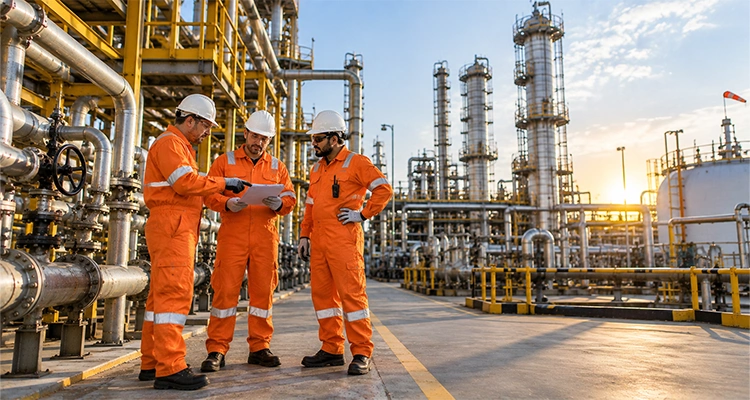
Refinery and offshore rig environments demand continuous protection against thermal energy and unexpected flash fires. A leading flame resistant (FR) clothing manufacturer utilizes advanced inherent or treated fabrics (such as Nomex® or specialized treated cotton blends) that will not melt or support combustion. These garments are constructed with non-conductive, spark-free hardware to eliminate secondary ignition sources during a flash event.
2. Mining & Exploration Demands
Underground and surface mining require highly durable materials that can withstand intense abrasion, mud, and mechanical strain. Safety workwear suppliers engineer these sets with reinforced triple-stitched seams and heavy-duty ripstop weaves. They incorporate specialized pocket configurations designed to secure essential field instruments and communication gear without compromising mobility.
3. Construction & Infrastructure Logistics
Active construction zones require workers to be visible across all shifts to prevent heavy equipment accidents. Top-tier suppliers of high visibility safety apparel integrate professional retroreflective bands with contrast background fabrics to ensure workers remain clearly visible during day, night, and inclement weather conditions.
4. Cold Storage & Freezer Facilities
Logistics of workers operating in deep-freeze environments require continuous thermal management without excessive bulk. Specialized manufacturers develop cold storage & freezer workwear with advanced multi-layer polyfill insulation and seam-sealed windproof outer shells. This configuration traps vital body heat while allowing metabolic moisture to escape, preventing internal condensation.
Step-by-Step Quality Inspection Checklist for Industrial Workwear
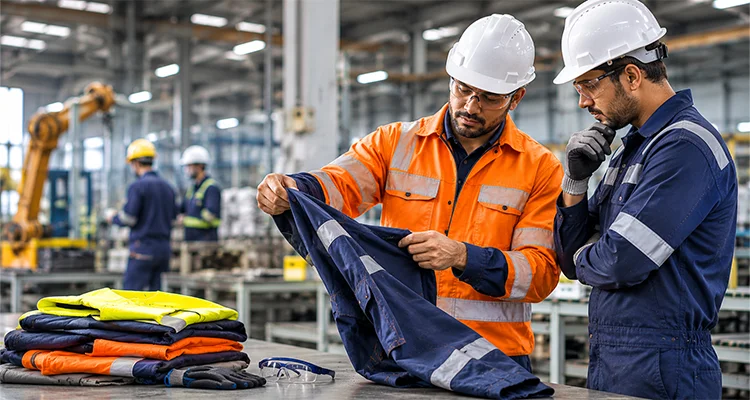
To maintain site safety and regulatory compliance, quality control managers should enforce this definitive inspection routine upon receiving bulk apparel shipments.
1. Material and Visual Inspection
- Verify that all fabric weights match the approved product specification sheet (GSM verification).
- Check for uniform color consistency across all dye lots to maintain corporate brand alignment.
- Ensure that all flame-resistant and high-visibility regulatory labels are permanently attached and legible.
2. Structural and Seam Verification
- Confirm the presence of heavy-duty triple stitching on high-stress panels (crotch, armpits, and side seams).
- Inspect all stress points for structural bar-tacking reinforcements.
- Test the functionality of two-way heavy-duty brass or nylon zippers under tension.
3. Functional and Safety Hardware Checks
- Check that retroreflective tape orientation complies perfectly with EN ISO 20471 placement layout rules.
- Confirm that all closures, snaps, and buttons are completely covered or non-conductive to satisfy electrical safety metrics.
- Inspect interior pocket linings for thread separation or structural defects.
What Operational Challenges Do Industrial Apparel Manufacturers Face?
Creating high-performance technical apparel requires managing complex material and operational demands. Top-tier manufacturers navigate these manufacturing friction points through rigorous engineering and updated production lines:
- Balancing Safety with Breathability: Heavy protective treatments can reduce airflow. Advanced mills utilize lightweight, moisture-wicking synthetic-natural hybrid blends to maximize comfort without sacrificing safety.
- Withstanding Demanding Wash Cycles: Workwear must survive repeated high-temperature commercial cleaning. Industrial uniform exporters use premium vat dyes and double-twisted yarns to prevent color loss and structural shrinkage over time.
- Maintaining Global Supply Chains: Sourcing raw components like anti-static grid fibers requires reliable vendor networks. Top manufacturers use vertical integration to ensure steady production timelines.
Future Innovations: What Is Next for Industrial Workwear?
The technical garment landscape continues to change as industrial facilities modernize. Progressive manufacturers are actively integrating advanced technologies into their production runs:
- Smart and Connected Textiles: Integrating low-profile digital sensors to track worker vital signs, ambient environmental heat indices, or real-time location details on dark jobsites.
- Sustainable Industrial Workwear Solutions: Moving toward eco-friendly initiatives by incorporating recycled polyester yarns, non-toxic chemical treatments, and solar-driven processing facilities.
- Precision Technical Customization: Utilizing computer-aided 3D pattern software to minimize factory fabric waste while adjusting sizes for complex industrial job requirements.
ACI Workwear: Your Trusted Industrial Workwear Manufacturer
As a leading industrial workwear manufacturer and certified safety clothing exporter, ACI Workwear engineered over a decade of performance into specialized protective apparel. From our solar-powered manufacturing facilities in India, we supply heavy industries across more than 25 countries-including the USA, UK, Eurozone, and Middle East markets.
Our capabilities span advanced production categories:
- Flame Resistant (FR) Clothing Manufacturer: Designing high-integrity thermal barriers compliant with global NFPA and EN certifications.
- Supplier of High Visibility Safety Apparel: Integrating premium reflective systems engineered for extreme construction, railway, and mining environments.
- Industrial Uniform Exporter: Delivering direct-to-door bulk shipments with full control over custom textile design, thread selection, and specialized trim assemblies.
We eliminate the traditional supply chain middleman to deliver field-tested, certified protection directly to your procurement hubs.
Ready to optimize your company’s safety compliance strategy and lower your long-term uniform replacement expenses? Request for Quote from Our Technical Team
Conclusion
Protecting your workforce requires apparel built for the realities of heavy industry. ACI Workwear combines advanced material engineering with large-scale manufacturing capacity to deliver high-performance safety apparel to worksites worldwide.
Avoid supply chain delays and variable garment quality by partnering directly with a proven global exporter.
Explore Our Industrial Product Catalog or Schedule a Consultation with Our Specialists to secure certified safety gear tailored to your specific operating environment.
Frequently Asked Questions
1. What is the minimum order quantity for custom industrial apparel?
Minimum order quantities vary based on specific custom fabric requirements; typical production configurations start at 500 units per style to optimize manufacturing runs.
2. How many industrial washes can flame-resistant clothing withstand?
Inherent FR fabrics retain protective characteristics permanently for the life of the garment, while treated FR options from premium manufacturers are certified to maintain compliance for over 50 intense industrial wash cycles.
3. Can high-visibility clothing be customized with corporate branding?
Yes, company logos can be integrated using flame-resistant embroidery threads or specialized heat-transfer prints without altering the certified background area requirements of EN ISO 20471.
4. What is the average lead time for global bulk shipments from India?
Standard production and transit times typically range from 6 to 10 weeks, depending on the volume of the order, fabric customization complexity, and final delivery destination.
5. Do you provide fabric samples for internal lab testing before manufacturing?
Yes, pre-production sample swatches and prototype garments can be supplied along with certified laboratory test reports for internal corporate review.
6. How do you verify that your workwear is manufactured sustainably?
Our facilities utilize grid-interactive solar power systems, incorporate certified recycled polyester fibers, and follow advanced waste minimization strategies to lower total manufacturing emissions.
Read more