


Top Arc Flash Protective Clothing Manufacturers in India: What to Verify Before You Buy
24/11/2026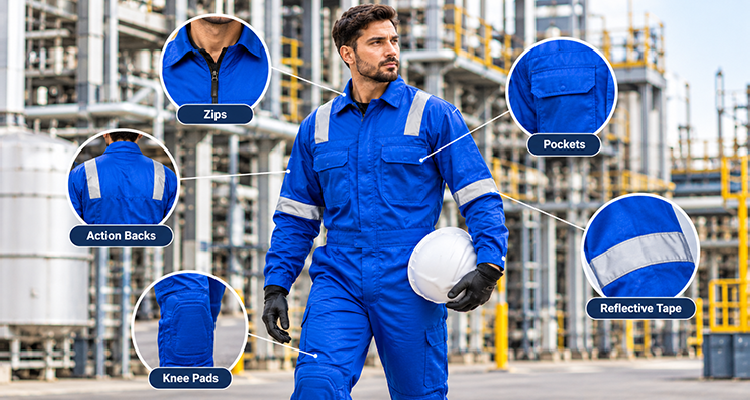
 Yash Agarwala
on

Yash Agarwala
Associate Director – ACI Workwear
Yash Agarwala is a Associate Director at ACI Workwear, a company focused on manufacturing high-performance safety garments and industrial workwear. He is actively involved in scaling operations, improving manufacturing efficiency, and building global partnerships.
The right industrial coverall features depend on what the wearer does and what they are exposed to. A two-way zip can make a general workwear coverall easier to put on. For flame-resistant (FR) or arc-rated coveralls, the priority is keeping protective closures fastened as intended. Knee pad pockets and reflective tape also need more than a visual check. The pad must suit the garment, and the hi-vis class applies to the finished garment.
Use this guide to specify zips, pockets, action backs, knee pads and reflective tape before approving a bulk order.
Key Takeaway
- Specify coverall features from the task and hazard assessment.
- Check zips, pockets and action backs on a finished sample.
- Verify knee pad compatibility and the finished garment’s hi-vis class.
- Match care, repair and laundering requirements to the approved style.
Which Industrial Coverall Features Matter Most?
Start with the task and the site’s hazard assessment. Decide which features help the wearer do the job and which must meet a protective clothing standard. Use a finished sample to check both.
| Feature | What It Does | What to Check |
| Front and ankle zips | Make the coverall easier to put on and remove. | Position, full closure, operation and protective flap where specified. |
| Pockets | Keep tools and devices within reach. | Placement, closures, reinforcement and access during the task. |
| Action back | Adds room for reaching and bending. | Fit in working positions and suitability for the hazard. |
| Knee pad pockets | Position pads for kneeling work. | Pad compatibility, performance level and pocket height. |
| Retroreflective bands | Improve visibility under directed light. | Finished-garment class, band layout and care instructions. |
How Should Coverall Zips Be Specified?
Check whether workers can fasten the zip fully, operate it with any required gloves and open it easily when removing the garment. A two-way zip can aid dressing or allow adjustment on general workwear where the task permits. Ankle zips can make it easier to don or remove the garment around boots. Follow the garment’s wearing instructions and keep protective closures fully fastened while working where flame or arc-flash protection is required.
For flash-fire clothing, request documentation for the applicable NFPA 2112 requirements for hardware, sewing thread and other components. Under EN ISO 11612, hardware that penetrates the outer material must be shielded from the innermost surface. Openings must be designed to keep out heat, flame or hot material. On arc-rated garments, check the finished model’s documentation against the site’s specification, including the closure design. ACI’s FR coverall guide explains how to review fabric and garment construction together.
If you’re choosing between zip and flap designs, get in touch with ACI Workwear. Share the task, the required standard and the gloves workers wear so the team can discuss which closures to assess on a sample.
What Pocket Layout Suits an Industrial Coverall?
List what workers carry before you set a pocket count. Chest pockets can hold small devices, while leg pockets can keep frequently used tools within reach. Check whether workers can access each pocket while sitting, kneeling or wearing other equipment. Secure closures help retain items, and bar tacks can reinforce points that see frequent use.
Side-access openings can be useful on general workwear. On heat- and flame-protective garments, check how those openings are protected and confirm that pocket materials meet the applicable requirements. Where molten-metal splash protection is specified under EN ISO 11612, additional rules apply to external pockets and closures. A generic flap is not evidence of compliance with those design requirements.
What Is an Action Back and When Is It Useful?
An action back adds room across the back and shoulders through a pleat, a gusset or a stretch panel. Ask workers to reach forward and overhead, bend and crouch in the sample. Check for pulling at the shoulders, seat and crotch. An action back can help with movement when the garment fits correctly.
Where the garment has a protective claim, verify that the stretch panel, elastic or pleat design is covered by the garment documentation as applicable. For EN ISO 11612 molten-metal splash protection, exterior pleats must be designed so molten material cannot collect at their bottoms.
How Do Knee Pad Pockets Work Under EN 14404?
Type 2 knee protectors are used with garments. EN 14404-3:2024 covers a specific pad-and-garment combination. EN 14404-4:2024 covers interoperable pads and garments designed with compatible pockets. Check the applicable part and the manufacturer’s compatibility instructions before substituting a pad, even if it fits the pocket.
| Level | Test Surface | Penetration Resistance |
| 0 | Flat, even surface | No penetration protection |
| 1 | Flat, even surface | At least 100 N |
| 1U | Uneven surface | At least 100 N |
| 2 | Uneven surface | At least 250 N |
Choose the level for the actual surface and task. During the fit trial, confirm the pad stays centred under the knee while the wearer kneels. For a coverall that also carries an FR or arc-protection claim, ask the garment manufacturer which knee pad configurations are suitable for that use. Inspect and replace pads in line with the manufacturer’s instructions.
What Should You Check on Reflective Tape?
Fluorescent background material supports daytime visibility. Retroreflective bands return directed light, such as vehicle headlights, toward its source. EN ISO 20471 sets the requirements for the finished hi-vis garment. The minimum visible areas below apply when the garment uses separate background and retroreflective materials.
| Garment Class | Background Material | Retroreflective Material |
| Class 1 | 0.14 m² | 0.10 m² |
| Class 2 | 0.50 m² | 0.13 m² |
| Class 3 | 0.80 m² | 0.20 m² |
Class 3 requires the garment to cover the torso and include retroreflective bands on sleeves, full-length trouser legs, or both. A long-sleeved coverall must meet the applicable design and material performance requirements as well as the area minimums.
- Band layout. Retroreflective bands on coveralls covering the torso, arms and legs must be at least 50 mm wide and meet the applicable placement rules.
- Size and branding. Verify the visible areas on the smallest size offered. Logos and labels must leave the required visible areas intact.
- Laundering. Check the finished garment’s specified wash method and any stated cycle limit. A tape supplier’s wash result can depend on the fabric the tape is applied to.
- Combined protection. Where a coverall is specified for both visibility and flame or arc protection, request evidence for the finished style, including the trim as applied. Check for fading, soiling, peeling and damage during routine inspections.
ACI Workwear also lists a Reflective Coverall in its general workwear range. Verify the finished garment’s class when specifying any model for hi-vis PPE.
If your site specifies a hi-vis class or uses an industrial laundry, compare the Manhattan and Brighton coveralls in ACI Workwear’s high-visibility range. Ask for the class and care instructions for the exact style before approving the tape layout.
Which Coverall Features Matter Most by Industry?
Use these examples to shortlist features, then check the applicable standard and any operator or site specification.
| Work Setting | Features to Review | What to Verify |
| Construction | Knee pad pockets, tool pockets and visibility. | EN 14404 where kneeling protection is needed. EN ISO 20471 where hi-vis PPE is specified. |
| Rail | Band layout, garment coverage and secure fasteners. | Operator requirements. For UK lineside work, check RIS-3279-TOM where applicable. |
| Electrical and power | Closure design, coverage and mobility. | Documented arc performance where required by the risk assessment. Check ASTM F1506 or IEC 61482-2 as specified. |
| Oil and gas | Protected openings, closures and pocket construction. | NFPA 2112 for specified flash-fire protection. Check EN ISO 11612 where applicable to the heat and flame hazard. |
| Manufacturing | Action back, reinforced pockets and kneeling protection. | Fit during the actual task and the protection specified by the site assessment. |
For electrical tasks that require arc protection, compare the documentation for the exact style in the FR and arc-resistant range.
What Should a Coverall Specification Checklist Include?
- Record the tasks, exposure hazards and applicable standards.
- Specify the zip, flap, pocket layout and intended closures.
- Trial the garment in the positions workers use on the job.
- Record the knee pad type, level and compatible configuration.
- Verify the finished-garment hi-vis class, layout and care instructions.
- Review the model’s documentation and approve a production sample.
- For sample approval and batch traceability, use the supplier checklist.
Conclusion
If you’re preparing a bulk order, request a quote from ACI Workwear with the intended use, required standards, size range and laundering method. Include any features your team wants to assess on a production sample.
Frequently Asked Questions
1. Is a Two-Way Zip Worth Specifying?
It can make dressing and adjustment easier where the task allows. For protective coveralls, check the finished closure design and keep it fastened as directed during exposure.
2. Can Any Knee Pad Be Used With Any Coverall?
Use the manufacturer-specified pad-and-garment combination under EN 14404-3:2024 or a compatible interoperable configuration under EN 14404-4:2024. A pad that fits the pocket still needs documented compatibility.
3. What Is an Action Back on a Coverall?
An action back is a pleat, gusset or stretch panel that adds room across the back and shoulders when the wearer reaches or bends.
4. What Hi-Vis Class Should a Coverall Have?
Select the class from the site risk assessment and applicable work requirements. Verify the finished garment’s class for the model and configuration being ordered.
6. Does Reflective Tape on FR Coveralls Need to Be Flame Resistant?
The trim as applied must be suitable for the garment’s flame-protection claim. Ask for documentation covering the finished garment and the reflective trim used on that style.
7. Can FR Coveralls Be Repaired With Ordinary Thread?
Use the manufacturer’s approved repair procedure and specified materials. Confirm the thread, patch fabric and any replacement hardware before returning the garment to service.