

Best FR & Arc Flash Resistant Clothing Manufacturers in 2026
14/07/2026
How to Choose the Right Flame-Resistant (FR) Clothing for Different Industries
06/08/2026
 Yash Agarwala
on
Yash Agarwala
on

Yash Agarwala
Associate Director – ACI Workwear
Yash Agarwala is a Associate Director at ACI Workwear, a company focused on manufacturing high-performance safety garments and industrial workwear. He is actively involved in scaling operations, improving manufacturing efficiency, and building global partnerships.
Inherent FR clothing provides permanent flame resistance built into the fibre. Treated FR clothing uses a chemical finish that can degrade over time. For high-risk environments such as Oil & Gas, Mining, Chemical, and Steel, inherent FR is the stronger long-term choice.
Across industrial sites globally, safety managers and procurement lead face the same question: which type of flame-resistant clothing provides better protection, better value, and better long-term compliance?
This guide gives you a direct, technical comparison so you can make a safer, more cost-effective decision for your workforce.
Key Takeaways
- Inherent FR clothing provides permanent flame resistance built into the fibre itself. It does not wash out and is the recommended choice for high-risk industries including Oil & Gas, Mining, Steel, and Chemical.
- Treated FR clothing relies on a chemical finish that can degrade over time. It is a viable option for lower-risk environments when a structured inspection and replacement programmed is in place.
- The choice between inherent and treated FR should always be based on your industry’s actual risk profile, not upfront cost alone.
- All FR clothing must comply with relevant standards including NFPA 2112, EN ISO 11612, or IEC 61482. Source only from certified safety clothing exporters with third-party test documentation.
- Regular pre-use inspection and a defined wash-cycle replacement schedule are essential for treating FR garments to maintain compliant worker protection.
- Sustainable industrial workwear solutions favour inherent FR: longer garment lifespan means less textile waste and fewer replacement cycles over time.
What Is Flame Resistant (FR) Clothing?
Flame resistant (FR) clothing is personal protective equipment designed to self-extinguish when a heat or flame source is removed. It does not prevent burns entirely, but it significantly reduces injury severity by stopping the garment from continuing to burn.
FR clothing is mandatory across several high-risk industries including Oil & Gas, Chemical processing, Electrical utilities, Mining, Construction, and Steel manufacturing. It is regulated under international safety standards including NFPA 2112, NFPA 70E, EN ISO 11612, and IEC 61482.
As an established industrial workwear manufacturer and certified safety clothing exporter, ACI Workwear produces FR garments compliant with these standards for clients across global industrial markets.
What Is the Difference Between Inherent and Treated FR Fabric?
The core difference lies in how flame resistance is achieved. Inherent FR fabrics are made from fibres that are flame resistant at the molecular level. Treated FR fabrics start as regular fibres and are chemically processed to become flame resistant.
What Is Inherent to FR Clothing?
Inherent FR clothing uses fibres that are naturally flame resistant as part of their chemical structure. Common inherent FR fibres include Nomex, Kevlar, Modacrylic, and FR Viscose blends.
The protection does not wash out, degrade over time, or depend on a chemical coating. Every thread in the garment is flame resistant from the moment it is manufactured to the moment it is retired from service.
Key characteristics of inherent FR clothing:
- Permanent flame resistance with zero washout risk
- Maintains protection even when the garment is worn, torn, or cut
- Higher upfront cost, but longer usable garment lifespan
- Common in Nomex and meta-aramid based industrial uniforms
- Preferred for high-risk, high-exposure environments
What Is Treated FR Clothing?
Treated FR clothing begins as a standard cotton or polyester-cotton blend fabric. A flame-resistant chemical finish is applied to the fabric surface during manufacturing.
This finish provides effective protection initially, but it can degrade with repeated washing, UV exposure, contamination, or improper storage. The level of flame resistance may reduce over time if the garment is not maintained according to the manufacturer’s care instructions.
Key characteristics of treated FR clothing:
- Lower initial purchase cost
- Effective protection when new and correctly maintained
- Protection can diminish with repeated industrial laundering
- Better suited for lower-risk applications or infrequent use
- Common in proband-treated cotton workwear
Inherent vs Treated FR Clothing: Side-by-Side Comparison
| Feature | Inherent FR | Treated FR |
| Flame Resistance Source | Built into the fibre permanently | Chemical finish on the surface |
| Durability of Protection | Permanent – does not wash out | Can degrade with washing and wear |
| Upfront Cost | Higher | Lower |
| Long-Term Value | Better (longer garment lifespan) | Depends on maintenance quality |
| Best For | Oil & Gas, Mining, Steel, Chemical | Construction, Agriculture, low-risk tasks |
| Compliance Standards | NFPA 2112, EN ISO 11612, IEC 61482 | NFPA 2112 (when new), EN ISO 11612 |
| Washability | Standard industrial laundering safe | Must follow strict care label instructions |
| Arc Flash Protection | High (with verified ATPV rating) | Moderate – check arc rating at purchase |
| Risk if Neglected | Minimal (protection retained) | Significant (protection may be lost) |
| Recommended Industries | High-risk, continuous-exposure workplaces | Moderate-risk or budget-limited workplaces |
Which Industries Should Use Inherent FR Clothing?
Industries where workers face continuous or unpredictable exposure to flash fire, arc flash, molten metal splatter, or explosive gases should use inherent FR clothing as their standard PPE specification.
1. Oil and Gas
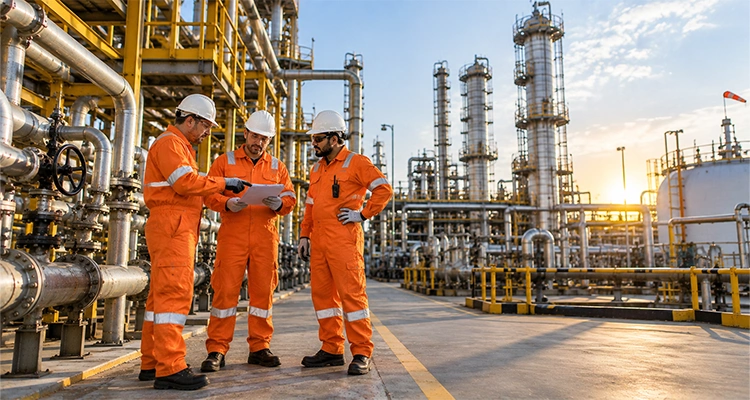
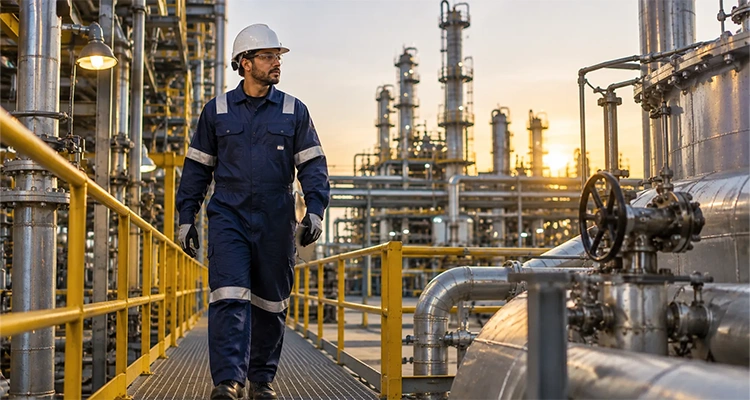
Workers in Oil & Gas face flash fire risk daily during drilling, refining, pipeline maintenance, and gas processing operations. Inherent FR garments provide reliable, permanent protection regardless of how many times the garment is laundered between shifts.
2. Mining and Steel
In Mining and Steel manufacturing, workers encounter radiant heat, sparks, and molten metal splatter. A treated FR garment exposed repeatedly to these conditions may lose protection of integrity faster than an equivalent inherent FR alternative.
3. Chemical and Electrical
Chemical plant workers risk exposure to flammable solvents and reactive substances. Electrical workers face arc flash hazards that demand arc flash protective clothing with a verified ATPV (Arc Thermal Protective Value) rating. Inherent FR fabrics maintain consistent arc flash protection through the full life of the garment.
4. Construction and Agriculture
For Construction workers and Agricultural workers with lower but real flame exposure risk, treated FR workwear from a reputable safety workwear supplier can be a viable option. The key is maintaining the garment correctly and replacing it on schedule.
Not sure which FR specification suits your industry? |
How Long Does FR Protection Actually Last?
Inherent FR garments retain their flame resistance for the full life of the garment, provided the fabric remains structurally intact. The protection is not affected by washing, general wear, or the passage of time.
Treated FR garments have a finite protection lifespan that depends on wash cycles, laundering methods, and the harshness of the working environment. As a general guideline, treated FR garments should be carefully inspected after every 25 to 50 industrial wash cycles.
Signs that a treated FR garment may have lost protection effectiveness:
- Visible fabric thinning or pilling across the garment surface
- Significant colour fading beyond normal expected wear
- Stiffness or brittleness in the treated fabric
- Missing or illegible certification label
- Structural weakness at seams or stress points
What Safety Standards Apply to FR Clothing?
Sourcing certified safety clothing from a compliant manufacturer is non-negotiable. Standards vary by region and industry, but the most widely recognised include:
- NFPA 2112: Standard for Flame-Resistant Clothing for Protection of Industrial Personnel Against Short-Duration Thermal Exposures from Fire. Widely applied in Oil & Gas and Chemical industries.
- NFPA 70E: Standard for Electrical Safety in the Workplace. Defines arc flash PPE requirements and arc flash protective clothing selection criteria.
- EN ISO 11612: European standard for protective clothing against heat and flame, covering convective heat, radiant heat, and contact heat performance.
- IEC 61482-2: International standard for arc flash protective clothing, specifying arc thermal performance requirements.
- AS/NZS 4602: Australian and New Zealand standard for High Visibility Safety Apparel used alongside FR garments in industrial environments.
- IS 11871: Indian standard for protective clothing, relevant for industrial uniform exporters and manufacturers supplying domestic industrial markets.
ACI Workwear produces flame resistant clothing that complies with NFPA 2112, EN ISO 11612, and other customer-specified international standards, with full traceability documentation available on request.
How Do You Inspect FR Clothing Before Each Use?
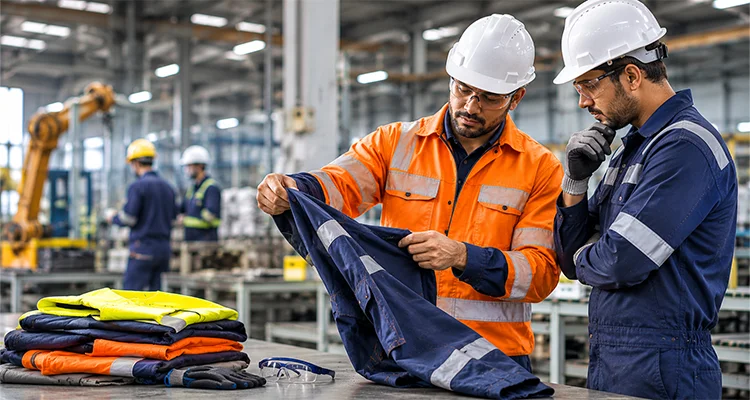
FR clothing that is damaged, contaminated, or degraded provides significantly reduced protection. Every worker entering a hazardous zone must complete a quick pre-use inspection using the checklist below.
| # | Check Point | What to Look For |
| 1 | Check the certification label | The garment label must show the FR standard it meets (e.g. NFPA 2112, EN ISO 11612). If the label is missing or illegible, remove the garment from service immediately. |
| 2 | Inspect for physical damage | Look for holes, tears, fraying seams, or worn-through areas. Any opening exposes skin directly to heat and flame. |
| 3 | Check for contamination | Grease, oil, solvents, and flammable chemicals on FR clothing create secondary fire hazards. Contaminated garments must be laundered or removed from service. |
| 4 | Verify the fit | FR clothing that is too loose creates entanglement hazards. Too tight, and it limits movement and may stress critical seams. |
| 5 | Check zippers and closures | Metal zippers must be intact and fully functional. Damaged closures can expose the inner layer and create concentrated burn points. |
| 6 | Inspect treated FR for degradation signs | Check for pilling, brittleness, significant colour fading, or visible thinning of the fabric surface. When in doubt, retire from the garment. |
| 7 | Review the wash record (treated FR only) | If the garment has exceeded the manufacturer’s recommended wash cycles, retire it regardless of visible condition. |
Need help building a site-specific FR workwear inspection protocol? Explore ACI Workwear’s range of certified flame-resistant clothing for industrial environments.
Is Treated FR Clothing Ever the Right Choice?
Yes. Treated FR clothing is a responsible choice in specific contexts. The key is matching the garment type to the actual risk profile of the role, not selecting based on cost alone.
Treated FR workwear is appropriate when:
- Workers face intermittent or low-frequency flame exposure
- Budget constraints make inherent FR cost-prohibitive at full workforce scale
- The work environment does not involve continuous thermal hazards
- A robust garment replacement and inspection schedule is in place and enforced
It is not appropriate to downgrade to treated FR to reduce procurement costs in high-risk zones. The cost difference between inherent and treated FR garments is far smaller than the liability and human cost of a preventable burn injury.
What Do Sustainable FR Workwear Solutions Look Like?
Sustainable industrial workwear solutions are increasingly important to procurement teams managing ESG commitments alongside safety requirements.
Inherent FR garments naturally support sustainability goals because they last longer, generate less textile waste, and reduce the frequency of replacement orders. Aramid fibres used in high-end inherent FR garments are also recyclable in many productions programmed.
ACI Workwear, as a manufacturer committed to responsible production, offers FR garment programmed designed to help industrial clients reduce their environmental footprint while maintaining full compliance with international flame resistance standards.
Why Source FR Clothing from a Certified Industrial Workwear Manufacturer?
Not all FR workwear on the market is created equally. Sourcing from a reputable Flame Resistant (FR) Clothing Manufacturer with third-party certification ensures that:
- The garment has been independently tested for the stated flame resistance performance
- The protection level matches the published safety standard
- The fabric meets the required fibre composition for the claimed FR type
- The manufacturer can provide traceability documentation for compliance audits
- Garment sizes and fit specifications meet the physical demands of the target industry
ACI Workwear is an established industrial workwear manufacturer and industrial uniform exporter supplying FR garments, High Visibility Safety Apparel, arc flash protective clothing, and cold storage and freezer workwear to clients across Mining, Oil & Gas, Steel, Chemical, Electrical, Railway, and Construction industries globally.
Request a product catalogue or bulk quote for FR workwear, High Visibility Safety Apparel, or arc flash protective clothing. Contact ACI Workwear‘s export team today.
Why Choose ACI Workwear for FR Clothing?
ACI Workwear is a leading industrial workwear manufacturer and global exporter trusted by procurement teams across Mining, Oil & Gas, Steel, Chemical, Electrical, Railway, and Construction industries.
| What We Offer | What It Means for You |
| Certified FR Manufacturing | All garments independently tested to NFPA 2112, EN ISO 11612, IEC 61482, and customer-specified standards. |
| Inherent & Treated FR Range | Full product range covering both FR types across multiple fabric weights, colours, and industry specifications. |
| Global Export Experience | Proven track record as an industrial uniform exporter supplying clients across Asia, the Middle East, Africa, and Europe. |
| High Visibility Safety Apparel | Combined FR and Hi-Vis garments are available for industries where both thermal and visibility protection are required. |
| Arc Flash Protective Clothing | Verified ATPV-rated arc flash garments for Electrical and Utility sector clients with full documentation. |
| Cold Storage & Freezer Workwear | Specialist cold-environment workwear available alongside FR ranges for multi-environment industrial operations. |
| Custom Sizing & Branding | Garments manufactured site-specific size charts with client branding, reflective tape placement, and pocket configurations. |
Explore ACI Workwear’s certified FR clothing range or request a sample pack. Contact our export team for a custom quote.
Conclusion
Whether your workforce needs inherent FR for continuous high-risk exposure or treated FR for lower-frequency hazards, the right choice starts with understanding your industry’s actual risk profile.
ACI Workwear makes that decision straightforward. As a certified safety clothing exporter and flame-resistant clothing manufacturer, we supply compliant, independently tested workwear built for the demands of real industrial environments.
Get in touch with ACI Workwear to discuss FR clothing requirements, request certified samples, or receive a custom quote for your workforce. |
Frequently Asked Questions About FR Clothing
1. Can I wash inherent FR clothing at home?
Yes. Inherent FR clothing can be machine washed at home or industrially laundered without any reduction in flame resistance. Always follow the care label for temperature and detergent guidance.
2. How do I know if my FR clothing has lost its protection?
For treated FR: signs include fabric thinning, brittleness, pilling, and a missing or illegible certification label. For inherent FR, protection remains intact as long as the fabric structure is undamaged.
3. What is the arc rating on FR clothing?
The arc rating is the energy required to cause a second-degree burn through the garment, measured in cal/cm2. A higher ATPV (Arc Thermal Protective Value) indicates greater arc flash protective clothing performance.
4. Does FR clothing protect against all fire hazards?
FR clothing reduces burn injury from flash fires, arc flash, and radiant heat. It is not rated for sustained flame immersion, chemical burns, or molten metal splatter unless independently tested for those specific hazards.
5. What is the difference between FR and Hi-Vis workwear?
FR workwear protects against flame and thermal hazards. High Visibility Safety Apparel uses fluorescent and reflective materials for visibility in low-light or high-traffic environments. Some garments combine both FR and Hi-Vis properties.
6. How many wash cycles can treat FR clothing handles before it loses protection?
Most treated FR garments retain protection for 25 to 75 wash cycles when laundered correctly. Always follow the manufacturer’s garment care instructions and replacement schedule.
7. Which industries require inherent FR clothing as a mandatory standard?
Oil & Gas, Petrochemical, Electrical utilities, and Steel manufacturing typically mandate inherent FR clothing due to the continuous and unpredictable nature of thermal and arc flash hazards in those environments.
Read More: